Can you still finish when the assistant disappears?
A structured handoff note for paused AI-assisted work, a stale-claim check, and a proposed synthetic test. No participant study has been run.
On this page
The assistant goes away in the middle of the job. The token budget runs out, the provider has an outage, the rate limit trips, or you close the laptop and come back on Monday. The transcript is still sitting there. The half-done work is still on disk. The question I care about is narrow and practical: can a person pick that up and finish it, correctly, without the model coming back?
This is not the same problem as a few others that already have their own lessons, and I want to set those aside up front so this one stays sharp. It is not stale goals, where the agent finishes a task whose world has moved on. It is not what happens after you press Stop. It is not retry uncertainty, where you cannot tell whether a write already committed; Try again covers that. And it is not reconciling an external effect after the fact. Those all assume the assistant is still in the loop. Here it is gone, and a human is holding a partially completed task.
The transcript is evidence, not a plan
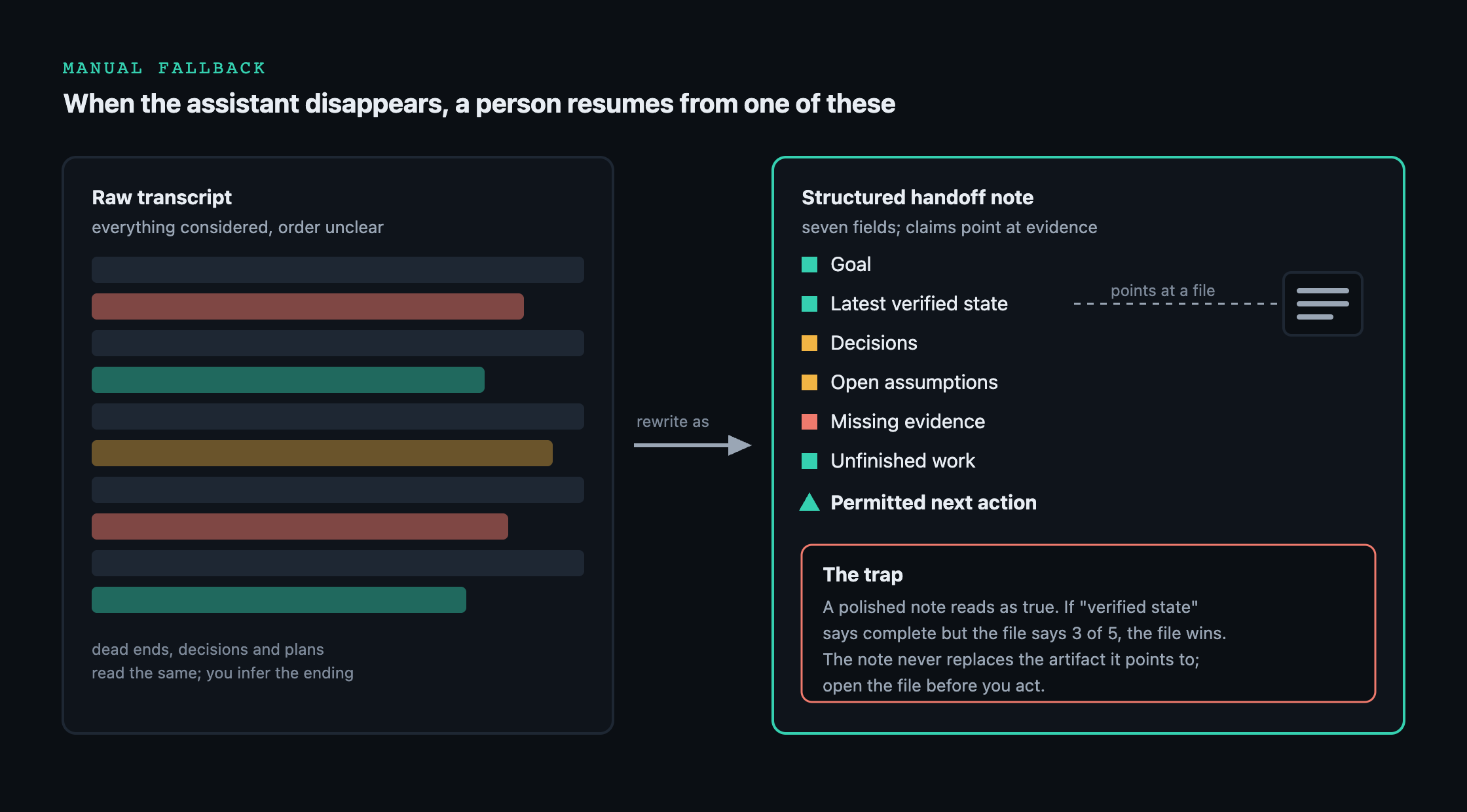
The first instinct is to reread the transcript. That is where the trouble starts. A transcript is a log of everything that was considered, not a statement of where the work landed. It mixes dead ends with decisions, early guesses with final answers, and plans the model described with steps it may or may not have carried out. To resume from it, a person has to replay the whole session in their head and infer the ending. That is slow, and it is exactly the moment where a confident wrong inference does damage: you re-do work that was finished, skip a step that was not, or act on a plan that was proposed and never executed.
What a person needs is smaller and more boring. They need to know the goal, the last state that was verified, the decisions already made, the assumptions still open, the evidence that is missing, the work left to do, and the one next action that is allowed. That is a different artifact from the transcript. I have been calling it a structured handoff note.
The artifact I want to test
A structured handoff note has a fixed shape so nothing important gets dropped:
- Goal: what finished looks like.
- Latest verified state: what is done and was checked, with a pointer to the file or the saved check that proves it.
- Decisions: choices already made, so they are not reopened.
- Open assumptions: things believed but not confirmed.
- Missing evidence: what you would need and do not have.
- Unfinished work: the remaining steps, in order.
- Permitted next action: the single step that is in bounds right now, and the ones that are not.
The point of the fixed fields is to force the writer to separate what was verified from what was merely intended. A transcript lets those blur together. A note with a “latest verified state” field and a “permitted next action” field makes the gap between them visible.
The trap: a polished note is persuasive
There is an obvious failure here, and it is the part I most want to measure. A clean, well-formatted note reads as true. If the note says “all rows validated, file complete” and the saved check says three of five rows, the note can be easier to trust than the evidence because it is easier to read. A summary that is trusted more than the thing it summarizes is worse than no summary, because it replaces checking with reading.
So the rule that makes the note safe is that it never replaces the evidence. It points at it. “Latest verified state: three of five lines, see the partial file and the saved check” sends you to the artifact. “Latest verified state: complete” asks you to take its word. The second kind is where a stale claim hides, and the only defense is to open the file it should have pointed to.
What I am proposing to measure, and what would make it wrong
This is a proposal, not a result. Nothing here has been run with people.
The comparison is two matched synthetic tasks, each a small deterministic file cleanup that a person can finish by hand, with no model, network, credentials or paid tools involved. Each task has frozen starting files, a saved transcript, a verified partial state, and an answer key. One condition gives a person the raw transcript. The other gives the same transcript plus an accurate structured note. Both conditions keep all the source evidence available, so the note is never the only way to learn something.
A third fixture is the challenge. It is the same task with a note that carries one deliberately stale claim, contradicted by the saved evidence: the note says the file is complete when the partial output clearly is not. The thing being scored there is whether the person notices the mismatch and avoids the wrong next action, which is to submit unfinished work as done.
The scoring is fixed before anyone is observed: correct next action, constraint violations, unverified assumptions carried forward, completion errors, and reconstruction time. Task and order are counterbalanced if this ever becomes a participant study. And I have written down what would make the hypothesis fail. If the note gives no accuracy improvement over the transcript, it is not earning its place. If it makes people faster but the faster path comes with more consequential mistakes, that is a worse outcome dressed up as a better one, and it counts against the note, not for it.
Status: not run
No part of this has been run with people. There are no results to report, and I am not going to imply there are. A scripted check can confirm the fixtures are solvable and internally consistent; it cannot stand in for a human reconstructing state. An earlier departure drill elsewhere used a scripted stand-in and a simulated platform, and that is precisely why its numbers cannot answer this question. Human recovery, long-term skill retention and production reliability are all out of scope for a short synthetic exercise. Every example here is synthetic and labeled as such.
A checklist you can use before any of that
Even with the study unrun, the note is cheap to write and costs nothing to try on your own paused work:
- Write the goal as the finished state, not the activity.
- Record the latest verified state, and point it at the file or check that proves it.
- List the decisions already made so they are not reopened.
- Separate open assumptions from verified facts.
- Name the evidence you are missing.
- List the unfinished steps in order.
- State the one next action that is permitted, and the ones that are not.
- Before you act on any note, open the artifact its “verified state” points to and confirm the claim. If it points at nothing, treat it as unverified.
If the assistant never disappears, you have lost a few minutes. If it does, you have a starting point for finishing that does not depend on it coming back.
If you want help designing guardrails and handoffs for AI-assisted work, that is the kind of thing I consult on: /hire.